
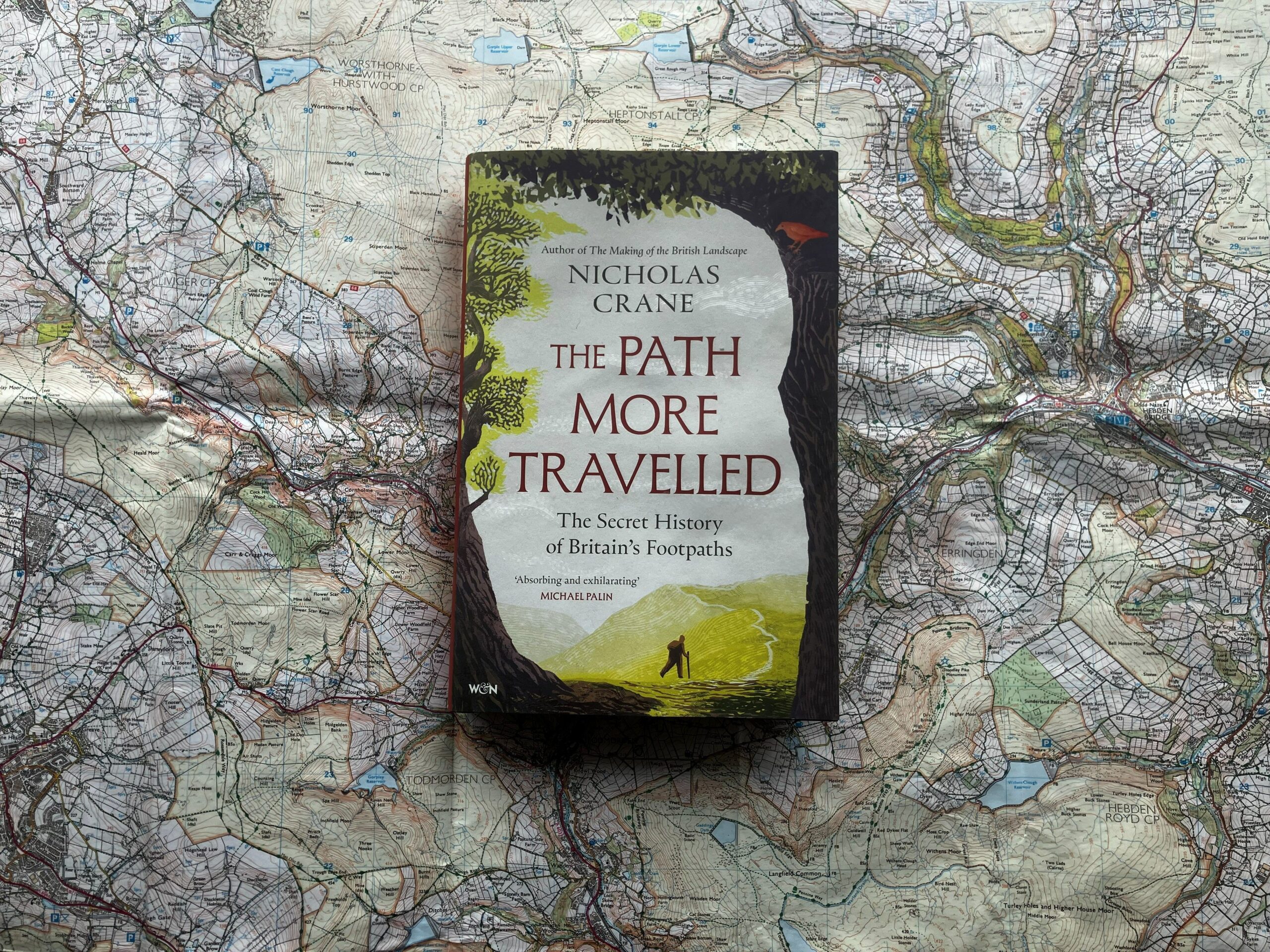
Nicholas Cage’s illuminating new book, The Path More Travelled, is subtitled ‘The Secret History of Britain’s Footpaths’; a descriptor which belies the sheer breadth and depth of subject matter contained within its covers.
Across 400 pages, the author takes us on a fascinating journey which not only plots how Britain’s paths, bridleways, trails and roads have evolved since the very first humans stepped on its soil, but also the environmental, social, economic and political factors which have shaped their development in the intervening 12,000 years.
Using a wide range of evidence, we find about how our nomadic ancestors used broad routeways and seasonal corridors to seek food and resources; how the development of neolithic mining and farming activities saw the establishment of the first ‘fixed’ pathways; and how horses, early carts, and the driving of livestock, all helped turn our footpaths into tracks, and our tracks into trails.
The book also describes how prehistoric mobility was driven by more than just basic needs, and that spiritual, cultural, and communal undertakings were powerful motivators for venturing into the unknown.
With Britain’s earliest known footprint dating from before 5,000 BC, evidence of early international exploration is another topic touched upon. For example, the book highlights how various archaeological discoveries prove that people from the Alpine regions of Europe were travelling to Britain as early as the Neolithic and Early Bronze ages.
As you might expect, the arrival of the Romans, and the indelible mark which their roads left on both our urban and rural landscape, is looked at in detail. But once Emperor Honorius had packed his bags and left Britannia to its warring hordes, we also discover how the Anglo-Saxons went about refining much of the transport infrastructure inherited from the occupiers.
One Anglo-Saxon legacy was the concept of a ‘highway code’ – and Crane returns to the laws governing our perambulations (both on and off-road) throughout the book to illustrate just how important the control of transport networks has always been to those in power.
The highway code is also one of several ‘through lines’ which helps ensure The Path More Travelled avoids being a collection of chronological milestones. It further uses vivid accounts of dramatic, bizarre and comical road-related incidents, pen-portraits of quirky characters from the past with a connection to our roadways, and personal anecdotes from the author himself, to help bring the tumultuous story of our highways and byways to life.
Plus there’s some myth-busting (e.g. Hadrian’s Wall probably wasn’t walkable along the top, most ancient ‘ridgeways’ weren’t used by people for long-haul journeys on foot), and other intriguing nuggets of historic research, which all help to keep the reader engaged.
For a book focused on walking and access to the countryside, its treatment of the aristocratic land-grab which followed the Norman conquest, the beginnings of widespread enclosure, and other barriers to open spaces which still resonate today, is refreshingly balanced.
And while The Path More Travelled clearly demonstrates how centuries of oppressive royal laws, narrow-minded governmental policies, global conflicts, and large-scale, profit-driven commercial activities, have all contributed to today’s ‘keep out’ culture, it also highlights how many of these interventions have helped to shape a complex labyrinth of paths, lanes, tracks, streets, alleys, bridleways, and roads, which is uniquely British.
One example is the infamous Beeching Report, which saw 5,000 miles of provincial railway lines being closed in the 1960s. Widely seen today as being a reckless act, and a disaster for our nation’s public transport provision, Crane makes the point that the Beeching policy has – inadvertently – led to the creation of thousands of miles of traffic-free paths which would have not otherwise existed.
The rise of the railroads themselves, the growth of Britain’s canal network, the invention of the bicycle, and the coming of the motor car, are equally documented in an even-handed way, as are the sections covering the mass trespass movement, the Rights of Way Act, the formation of the Rambler’s Association, and the establishment of our National Parks and National Trails.
Crane concludes The Path More Travelled expressing an obvious frustration that more hasn’t been done to build on these latter achievements, and calls for both a ‘right to routes’ and a public right to access more open spaces.
But what also permeates throughout the book is the sense that we owe it to ourselves to make more of what we’ve already got, with the author inviting us to look down at the well-trodden path beneath our boots and consider how it came to be there, who walked it before us, where they were going, and what our lives would be like without it.
The Path More Travelled: The Secret History of Britain’s Footpaths by Nicholas Crane (Hardback, RRP £25) is published by Weidenfeld & Nicolson.

Project partners